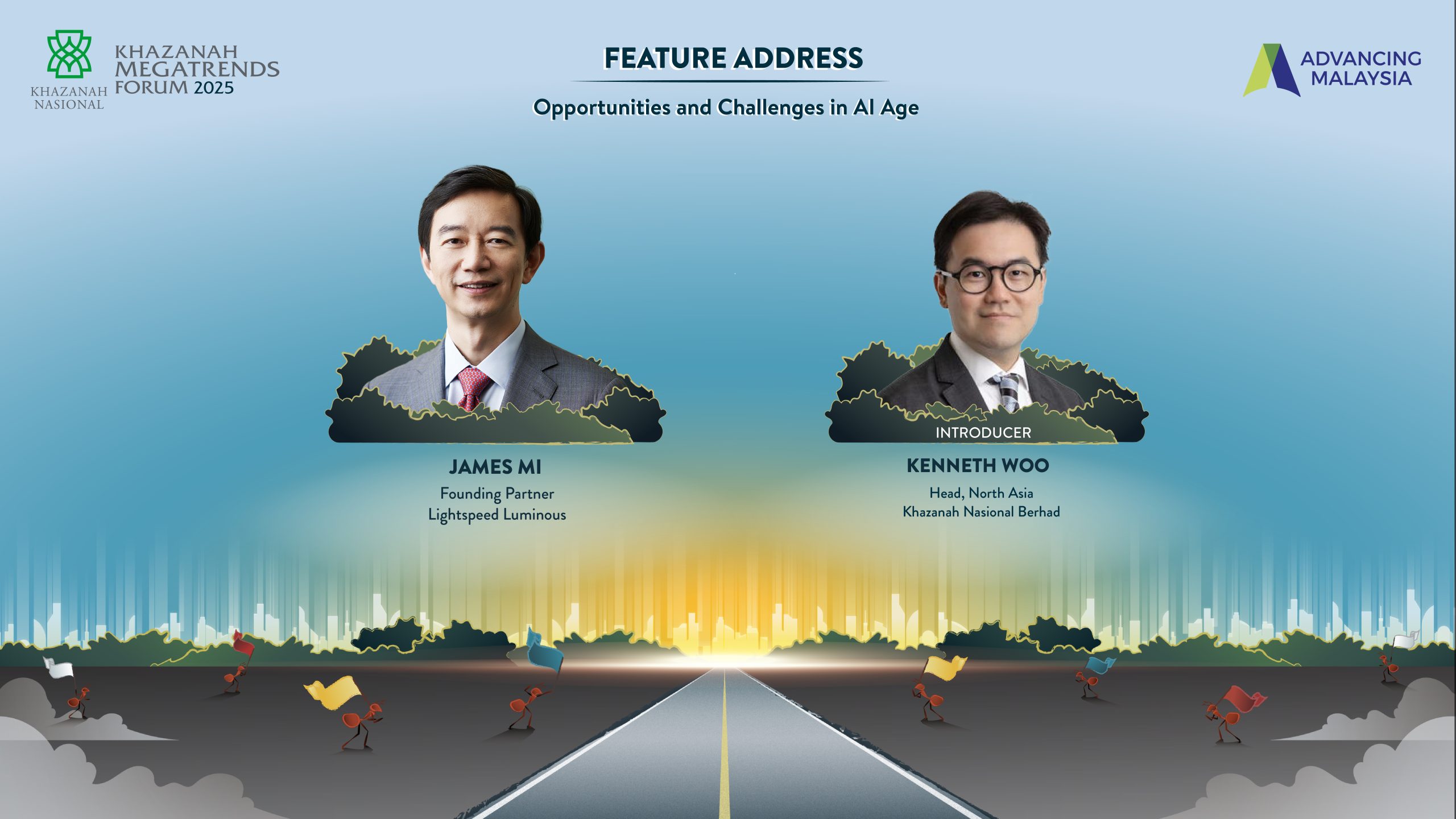
Session Summary
AI is driving a new industrial revolution.
The pace of AI adoption is accelerating at an unprecedented rate. Token generation is doubling every month, and it is likely that the world still underestimates the profound impact AI will have over the next ten years.
AI is transforming industries across the board. AI is a horizontal technology that enhances productivity across all sectors. For example, China’s DeepSeek breakthrough is already delivering improvements in healthcare across the country.
AI is powering a new industrial revolution through modern infrastructure. Just as automobiles, oil, and factories powered previous industrial revolutions, today’s wave of global transformation is being driven by semiconductors, electricity, and AI factories. These building blocks, especially data centres and GPU-powered infrastructure, now underpin the growth of AI across industries.
Value creation is shifting from ‘bits’ to ‘atoms’.
Hardware is the more valuable frontier. While software, large language models, and AI applications continue to drive digital innovation, true value creation increasingly lies in the physical backbone of intelligence—GPUs, networking systems, robotics, and clean energy infrastructure. The future of AI depends not just on algorithms, but on the physical infrastructure that powers them.
Hardware is proving far more capital-efficient than expected. Internet companies required hundreds of millions of dollars to scale amid fierce competition and inflated valuations, whereas deep-tech and hardware firms face fewer competitors, clearer moats, and more sustainable economics.
China’s experience illustrates this shift to hardware clearly. Over 200 China public listed unicorn deep-tech and climate-tech firms have created more than US$1 trillion in market value, often with just a fraction of the funding that internet peers raised. Investments in robotics, nuclear fusion, and brain–computer interfaces reveal how “atoms” now anchor both economic and societal progress.
Competing in the AI age requires efficiency, adaptability, and humanity.
The most competitive organisations deploy AI resourcefully. Successful integration is a combination of integrating private data to sharpen insights, using multiple models to avoid dependency, and leveraging open-source systems to reduce experimentation costs. Strategic flexibility, not scale alone, defines success.
The challenge ahead is in energy. OpenAI’s projected power demand could exceed Malaysia’s current power capacity by 2031, underscoring the urgency of climate-tech and energy innovation to sustain AI growth.
Human qualities remain essential in an AI-driven world. Even as AI reshapes knowledge work, human curiosity, empathy, and critical thinking remain irreplaceable. These traits ensure that AI augments human potential rather than replaces it, keeping innovation anchored in purpose and human connection.
Quotes
“Encourage empathy and the connection to people. That’s what makes us different from AI — it could be super-intelligent down the road, but our humanity is what sets us apart.”
– James Mi